Shedding Light on Drug Mechanisms: How Quantum Nuova Delivers Deeper Insight
Quantum sensing is unlocking a new frontier in drug discovery, capturing the earliest cellular responses to treatment in real time. Using fluorescent nanodiamonds, researchers can track free radical bursts inside living cells—pinpointing mitochondrial stress within just an hour of drug exposure, long before traditional methods detect any change. This breakthrough offers a powerful, precise window into a drug’s potency and mechanism of action, transforming how we evaluate efficacy at the subcellular level.
Quantum Sensing for Drug Potency and Mechanism of action (MoA) elucidation at sub-cellular location.
Free radicals, includes reactive oxygen species (ROS) and reactive nitrogen species (RNS), they are highly reactive molecules with an unpaired electron. While often associated with cellular damage and disease, they also play crucial roles in normal physiological processes, including cell signalling, Immune response and gene expression.
Free Radicals as Biomarker for Drug Potency and MoA elucidation
The use of free radicals as biomarker is a powerful and expanding area in drug potency testing. By providing insights into a drug’s mechanism and its effect on the cellular redox balance, these assays offer a more physiologically relevant approach to assessing drug efficacy and safety.
The core concept is that a drug’s therapeutic effect is often tied to its ability to modulate the production or scavenging of free radicals. Therefore, changes in free radical levels or related biomarkers can serve as a proxy for the drug’s potency.
Quantum NuovaTM offers a new tool to measure in real-time potency of different drugs and provide the earliest functional clue to drugs mechanism, catching a flash of oxidative stress inside cells (i.e breast cancer cells) within one hour of drug exposure. This quantum discovery—tracking free radical bursts in real time at the subcellular level—unveiled the cause-and-effect chain from mitochondrial stress to cellular collapse, long before traditional “omics” technologies detected any changes.
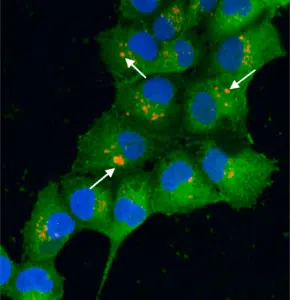
Figure 1. MDA-MB-231 human breast cancer cells. Cytoskeleton(green), Nuleus (blue), FNDs (red)
Using quantum sensing with fluorescent nanodiamonds (FNDs), Quantum Nuova, QT Sense’s platform, embeds atomic-scale nitrogen-vacancy (NV) centers in nanodiamonds that act as tiny magnetic sensors inside living cells [1,2]. These NV centers fluoresce under a laser, and their glow changes in response to local magnetic “noise”—essentially detecting unpaired electron spins from free radicals [2]. Free radicals (like reactive oxygen species, ROS) have unpaired electrons, creating magnetic fluctuations that NV centers pick up with extraordinary sensitivity [3]. In simple terms, the nanodiamonds light up in ways that directly reflect the cell’s oxidative stress level. This allows non-invasive real-time monitoring of biochemical reactions at the nanoscale: when testing drug triggers a burst of ROS in mitochondria, the NV centers sense the magnetic disturbance and alter their fluorescence accordingly [2]. The result is captured as T1 relaxation curves, translating quantum signals into actionable data on oxidative stress and directly related with the free radical concentration. Unlike conventional fluorescent dyes (which can bleach or can’t quantify radicals directly), the quantum approach provides quantitative, real-time kinetics of free radical generation, with submicron spatial resolution inside organelles.
Figure 2. Excitation of nitrogen vacancy centers in fluorescent nanodiamonds in cells
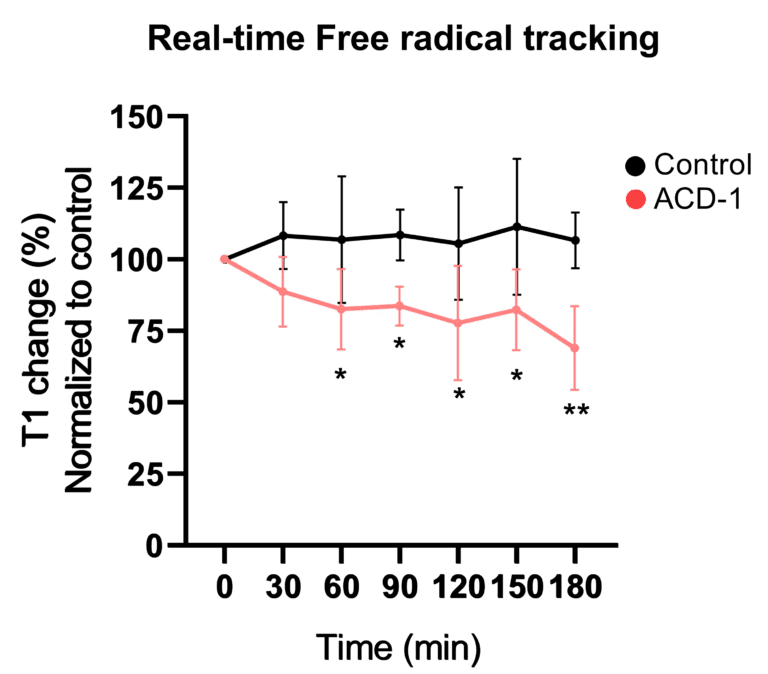
We tested our technology in an anticancer drug (ACD-1) recently granted accelerated approval by the FDA as the first ever systemic therapy for diffuse midline glioma—an aggressive brain tumour marked by the H3 K27M mutation [1], showing promising result for drug potency evaluation. The Quantum Nuova platform thus serves as an early warning system for cellular stress. As shown in Fig. 3, within minutes of exposing live breast cancer cells to an anticancer, the FND sensors registered a spike in free radical activity emanating from the mitochondria. This earliest functional “hit”—a surge of oxidative stress—was observed in about 1 hour of drug treatment, well before any visible changes in cell morphology or gene expression occurred. In control cells (no drug), the nanodiamond signal stayed flat, indicating no rise in oxidative stress; but in A-treated cells, the oxidative stress signal climbed rapidly, revealing that the drug was acutely perturbing mitochondrial function.
The graph below illustrates this real-time kinetic tracking: treated cells show a steep increase in the ROS-induced signal within 60 minutes, whereas untreated cells remain at baseline. Schematic graph of real-time mitochondrial oxidative stress in live cells. Within an hour of ACD-1 exposure, Quantum Nuova’s nanodiamond sensors detect a sharp rise in the oxidative stress signal (red line) compared to a stable baseline in control cells (blue line). This immediate spike reflects free radical generation in mitochondria as an early drug effect, indicating the potency of the drug using free radicals as biomarker.
Figure 3. Real-time free radical tracking after three hours (180min) of ONC-201 treatment. T1 real-time tracking obtained from the same FND-anti-VDAC2 particle in MDA-MB-231breast cancer cells before and after treatment. Control was measured first in cells grown in medium before the addition of ONC-201 (3 μM). T1 values were recorded every 30 minutes to observe the dynamic change. Each curve represents the average of three independent particles (one particle/cell per plate) and three measurements per time point normalized to time 0. T1 values of the ONC-201 group were statistically compared to those of the control group at corresponding time points. Significance between groups was analysed by one-way ANOVA with Fisher’s LSD post-hoc test *p ≤ 0.04, **p ≤ 0.0015. Error bars represents SD
In conclusion, Quantum sensing, using fluorescent nanodiamonds, is a powerful new tool for evaluating drug potency by detecting the rapid generation of free radicals at the subcellular level. This technology provides an early, real-time “hit” on a drug’s mechanism of action, revealing its effect on cellular processes like mitochondrial stress within one hour—far earlier than traditional methods. By tracking these free radical bursts as biomarkers, this quantum approach offers a more direct and efficient way to assess drug efficacy and pinpoint its impact on a cell’s redox balance, as demonstrated by the rapid and distinct signal observed in drug-treated cancer cells compared to untreated controls.
References
FDA Oncology Center of Excellence. FDA grants accelerated approval to dordaviprone for diffuse midline glioma. (Aug 6, 2025).
QT Sense B.V. – Quantum Nuova Product Site; How it works – NV center nanodiamond sensing.