
Why Quantum Nuova Goes Beyond Seahorse XF
For over a decade, Seahorse XF has defined mitochondrial respiration analysis. It measures oxygen consumption rate (OCR) and extracellular acidification rate (ECAR), providing valuable insight into cellular energy production. But mitochondrial biology is broader, spatial, and stress-driven — and many critical events occur before respiration changes.
Quantum Nuova captures what Seahorse cannot see.
While Seahorse reports bulk metabolic output from hundreds to thousands of cells, Quantum Nuova directly measures mitochondrial free-radical dynamics—the earliest functional signal of mitochondrial stress
Reactive oxygen species (ROS) bursts precede OCR collapse, membrane potential loss, proteostasis failure, and transcriptional rewiring. By detecting these ROS signals in real time, Quantum Nuova reveals when and where mitochondria first begin to fail.
The difference is fundamental:
- Seahorse detects consequences.
- Quantum Nuova detects cause.
Unlike Seahorse’s population-averaged readout, Quantum Nuova provides single-cell and subcellular resolution, distinguishing responder from non-responder cells and identifying organelle-specific stress.
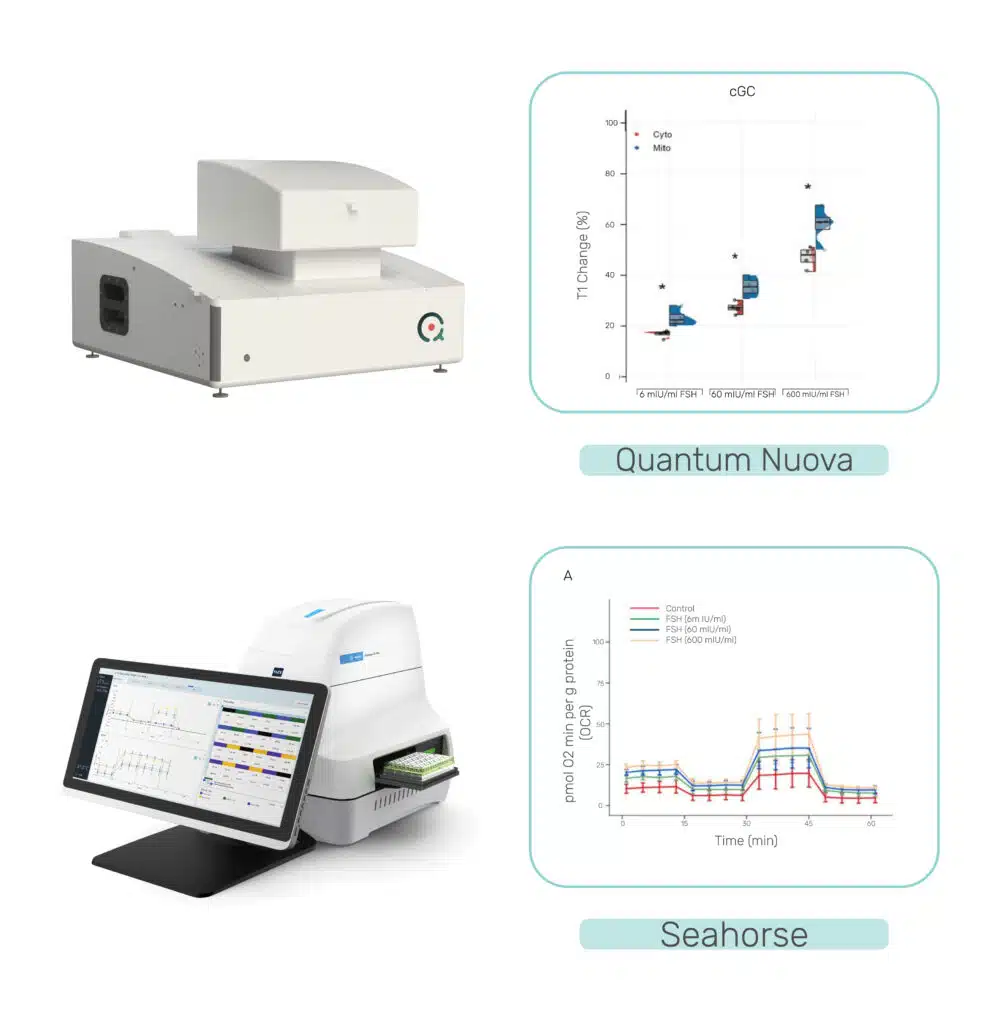
This spatial insight changes decisions—enabling earlier go/no-go calls, clearer mechanism-of-action understanding, and reduced late-stage toxicity risk.
Operationally, Quantum Nuova also delivers faster time-to-data. Slide comparisons show approximately 1 hour hands-on time versus 8–10 hours for Seahorse assays, with lower prep complexity and fewer failure modes
It is non-destructive, making it particularly valuable for precious patient-derived samples.
Perhaps most strategically, Quantum Nuova acts as a fast mechanistic filter. Before committing to a full Seahorse run, researchers can determine whether oxidative stress is involved and whether a compound induces early mitochondrial toxicity
Seahorse tells you how much energy cells make.
Quantum Nuova tells you why mitochondria are stressed—and which cells fail first.
In modern drug discovery and translational research, that difference is decisive.
Share this: